Hildegard von Bingen
1098–1179 · Abbess · Mystic · Composer · Healer · Doctor of the Church
Hildegard von Bingen was a 12th-century German Benedictine abbess who founded two monastic communities in the Rhineland-Palatinate region of Germany. One of the most influential women in European history, she was a polymath active in theology, music, art, medicine, philosophy, and natural science. She is considered the founder of scientific natural history in Germany, and was formally canonized and named a Doctor of the Universal Church by Pope Benedict XVI in 2012 — only the fourth woman ever to receive this honor.
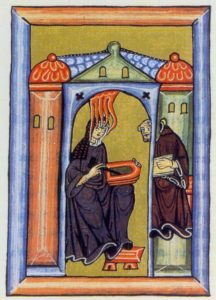
Theology and Visions
Hildegard received her first vision at age three and experienced them throughout her life, though she kept them largely private until a divine command at age 42 instructed her to write them down. With the support of her teacher Volmar and the approval of Pope Eugenius III, she completed her masterwork Scivias (“Know the Ways”) in 1151 — a record of 26 visions exploring the relationship between God, humanity, and creation.
Her other major theological works include Liber Vitae Meritorum (“The Book of the Rewards of Life”) and Liber Divinorum Operum (“The Book of Divine Works”), both still available in print worldwide. Her theology centered on the concept of viriditas — the greening power of God — the divine life force she believed was present in all of creation.
“All of creation is a song in praise to God.”
Hildegard von Bingen
Music and Composition
Hildegard composed over 70 liturgical songs — more than any other composer of the medieval period. Collected in the Symphonia armonie celestium revelationum (“Symphony of the Harmony of Celestial Revelations”), her music is distinctive for its wide melodic range and mystical character. She also composed Ordo Virtutum (“The Order of the Virtues”), the earliest known morality play and one of the earliest surviving musical dramas.
Her music continues to be performed and recorded by leading ensembles worldwide, finding new audiences among those drawn to its meditative, otherworldly quality. The film Hildegard Speaks features her music performed in the landscapes where she lived and composed.
Medicine and Natural Science
Hildegard’s medical texts Physica and Causae et Curae (“Causes and Cures”) documented hundreds of plants, animals, minerals, and their medicinal properties. Written in the 12th century, these works are considered foundational texts in the history of natural medicine and herbalism. She approached health holistically — connecting the physical, spiritual, and natural worlds in a way that anticipated modern integrative medicine.
Her concept of viriditas extended into her medical thinking — illness was understood as a loss of the divine green life force, and healing as its restoration through herbs, diet, and spiritual balance.
Visual Art and Illuminated Manuscripts
Hildegard’s illuminated manuscripts are among the most recognized examples of Romanesque art. Created with vibrant colors, gold leaf, and intricate detail, the illuminations depicted her visions — biblical scenes, celestial beings, and symbolic representations of the cosmos and the natural world. Her artistic expressions were inseparable from her theology — each image a visual rendering of her mystical experience.
The Scivias manuscript, produced at Rupertsberg Abbey under her direction, is the most celebrated. The original was lost during World War II, but a hand-copied facsimile made by the Benedictine nuns of Eibingen Abbey preserves its imagery in full.
Legacy and Influence
Saint Hildegard von Bingen’s legacy spans theology, music, medicine, art, and women’s history. She was one of the first women in Western history to be granted papal authority to write theological texts, and one of the few medieval women whose voice has survived in her own words. Her influence is felt today in Catholic theology, the early music revival, integrative medicine, feminist spirituality, and environmental thought.
The official Hildegard Pilgrimage Route through the Rhineland was opened in 2017, tracing the key locations of her life from Idar-Oberstein to the Abbey at Eibingen. The documentary series The Unruly Mystics and Hildegard Speaks bring her story to contemporary audiences worldwide.
Additional Resources
- Scivias — Wikipedia
- Saint of the Day — Franciscan Media
- Walk the Hildegard Way — September 2026 Pilgrimage