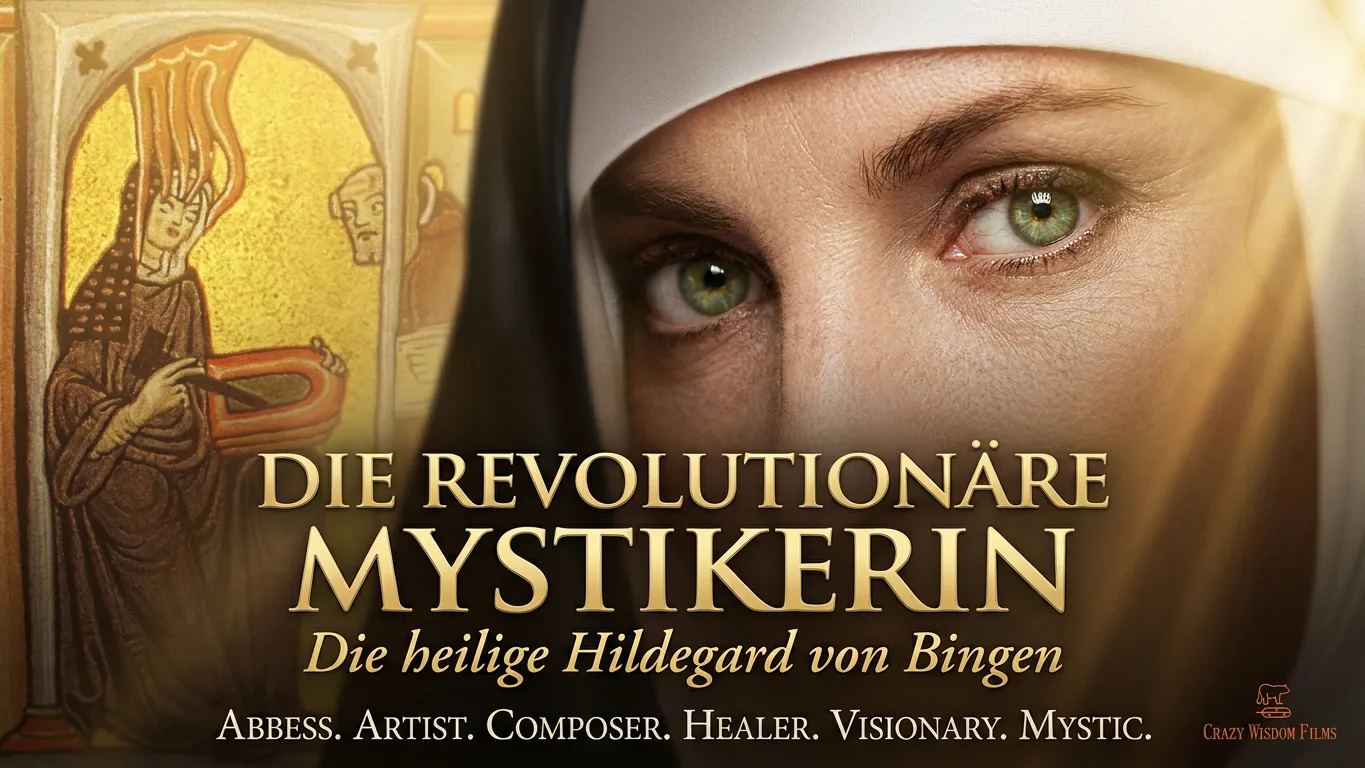
Who Was Saint Hildegard von Bingen?
·
She was a Benedictine abbess, a composer, a healer, a theologian, a visionary, and a prophet. Saint Hildegard von Bingen (1098–1179) was one of the most extraordinary figures of the medieval world — and one of the most relevant to our own.
A Life That Defied Its Time
Born in 1098 in Bermersheim, Germany, Hildegard was the tenth child of a noble family in the Rhineland. At the age of eight she was offered to the Church — a common practice for noble families at the time — and placed in the care of Jutta von Sponheim at the Benedictine monastery of Disibodenberg. She would live there for nearly 40 years.
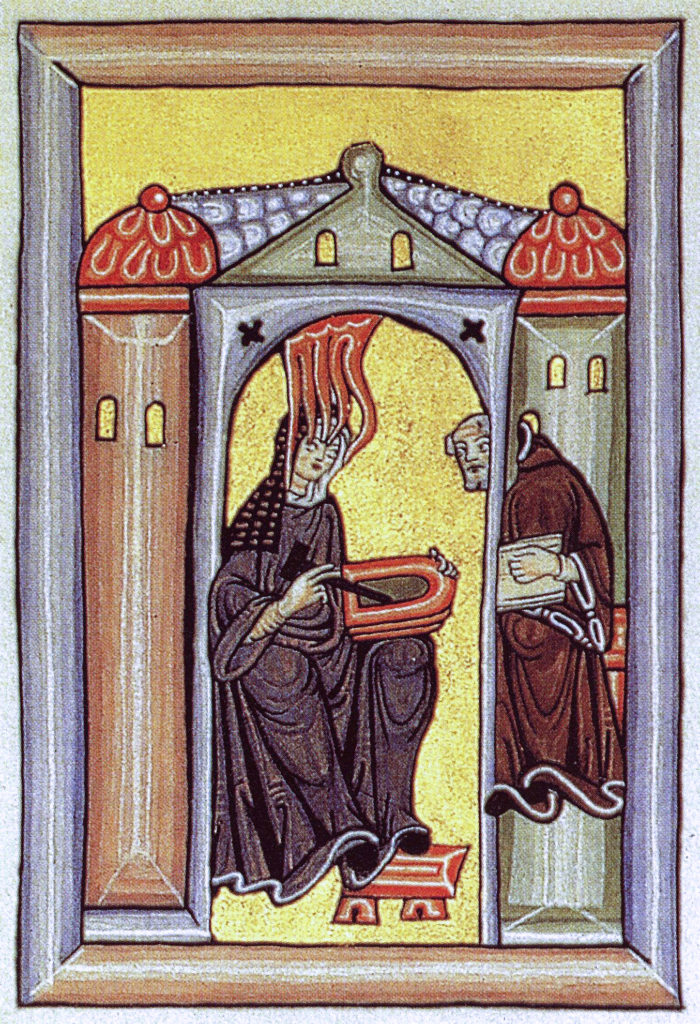
From childhood, Hildegard experienced visions — luminous, overwhelming encounters with what she called the “Living Light.” She kept them largely private for decades, confiding only in Jutta and later in her teacher and secretary, the monk Volmar. Then, at the age of 42, she received what she described as a divine command: write it all down.
“A fiery light of extraordinary brilliance came and permeated my whole brain, and inflamed my whole heart and my whole breast, not like a burning but like a warming flame.”
Hildegard von Bingen
The result was Scivias — “Know the Ways” — a record of 26 visions completed in 1151 and approved by Pope Eugenius III. It established Hildegard as a theological authority at a time when women were given no such standing. She was 53 years old.
What Made Her Unique
Hildegard was not simply a mystic who had visions. She was a polymath — a woman whose output across multiple disciplines remains astonishing even by modern standards.
As a composer, she wrote over 70 liturgical songs — more than any other composer of the medieval period. Her Ordo Virtutum is the earliest known morality play and one of the earliest surviving musical dramas in history. Her music, with its wide melodic range and otherworldly quality, is still performed and recorded worldwide.
As a healer, she wrote Physica and Causae et Curae — medical texts documenting hundreds of plants, minerals, and animals and their healing properties. She understood illness holistically, connecting the physical, spiritual, and natural worlds in a way that anticipates modern integrative medicine by nine centuries.
As a theologian, she developed the concept of viriditas — the greening power of God — the divine life force present in all of creation. It is one of the most original and enduring concepts in Christian mysticism.
As a leader, she founded two monastic communities — Rupertsberg Abbey near Bingen (c. 1150) and Eibingen Abbey (1165) — against considerable opposition, asserting an independence that was almost unheard of for a woman of her era.
Why She Matters Today
Hildegard was canonized and named a Doctor of the Universal Church by Pope Benedict XVI in 2012 — only the fourth woman in history to receive this honor, alongside Catherine of Siena, Teresa of Ávila, and Thérèse of Lisieux. Her feast day is September 17.
But her influence extends well beyond Catholic theology. Hildegard speaks to anyone who has ever felt the tension between the interior life and the demands of the world. Her concept of viriditas resonates with the environmental movement. Her medical writings are studied by practitioners of integrative and herbal medicine. Her music finds new audiences every year among people drawn to its meditative, transcendent quality.
She was also, quite simply, one of the first women in Western history whose voice survived — in her own words, on her own terms. She wrote, composed, preached, traveled, and corresponded with popes, emperors, and abbots. She pushed back when she disagreed and held her ground when challenged. In an era that offered women almost no public authority, she carved out a space entirely her own.
“All of creation is a song in praise to God.”
Hildegard von Bingen
Walk Where She Walked
The official Hildegard Pilgrimage Route — the Hildegardweg — opened in 2017, tracing 135 km through the Rhineland from Idar-Oberstein past the ruins of Disibodenberg, through medieval villages along the Nahe River valley, to the Abbey at Eibingen above the Rhine.
Each September, filmmaker-pilgrim Michael M. Conti leads a guided 10-day pilgrimage through this landscape — walking the trail, visiting the key sites of Hildegard’s life, attending evening concerts and workshops, and gathering at the Abbey on September 17 for the Feast Day celebration.
Further Reading
- About Saint Hildegard von Bingen — theology, music, medicine, and art
- The Films — The Unruly Mystic documentary series
- Pilgrimage Programs — scholars, theologians, and artists inspired by Hildegard
- Saint Hildegard Way — the 2026 pilgrimage through the Rhineland