Hildegard’s Music — Ordo Virtutum Explained
·
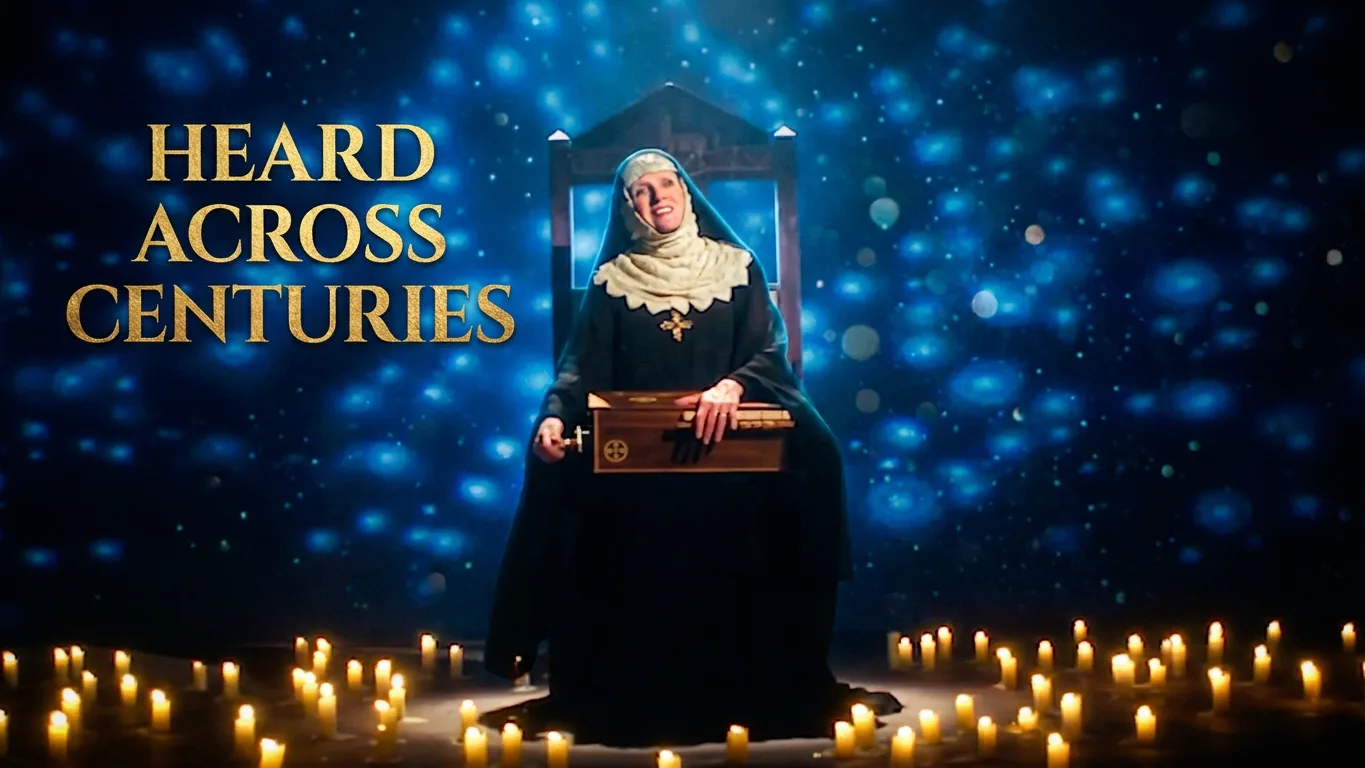
Eight centuries before opera existed as a form, a 12th-century Benedictine abbess in the Rhineland of Germany composed the first morality play in history — with music, drama, and theology woven into a single work that still astonishes audiences today. This is the Ordo Virtutum.
What Is the Ordo Virtutum?
Ordo Virtutum — Latin for “Order of the Virtues” — is an allegorical music drama composed by Hildegard von Bingen around 1151. It is the earliest morality play by more than a century, and the only medieval musical drama to survive with an attribution for both text and music. It predates the emergence of opera as a form by nearly 450 years.
Hildegard composed the Ordo Virtutum while asserting her independence, during the construction and relocation of her Abbey at Rupertsberg. It premiered in 1152 as part of the dedication ceremony of the new Abbey. In many ways it represents a turning point in her life — the moment she fully stepped into her own authority as a theologian, composer, and spiritual leader.
“The human intellect has great power to resound in living voices, and arouse sluggish souls to vigilance by the song.”
Hildegard von Bingen
The Story — A Battle for the Soul
The Ordo Virtutum is the story of the journey of the soul — “Anima” — and the battle between the Virtues and the Devil over the final destination of the soul. It is not a biblical narrative, not a saint’s life, not a miracle play. It presents an allegorical struggle between personified virtues and the Devil over the destiny of a human soul.
In the Ordo Virtutum, a female voice plays the role of the human soul. She encounters 17 virtues: Humility, Hope, Chastity, Innocence, Contempt of the World, Celestial Love, Discipline, Modesty, Mercy, Victory, Discretion, Patience, Knowledge of God, Charity, Fear of God, Obedience, and Faith. All the virtues are sung by women. The Devil alone speaks — he does not sing. Hildegard’s theological statement is precise: evil has no music in it.
The soul is torn between the virtues and the devil’s temptations, falls away, suffers, and is ultimately redeemed — carried back to God by the virtues who surround her. It is a drama of spiritual struggle that is entirely universal, entirely human, and entirely Hildegard’s own invention.
The Music — Unlike Anything Before or After
Hildegard’s musical language is immediately recognizable — wide melodic leaps, long soaring phrases, an otherworldly quality that seems to exist outside of time. Her chants don’t behave like conventional Gregorian plainchant. They reach higher, fall further, and hold notes in ways that feel more like ecstatic speech than formal liturgy.
The Ordo Virtutum is included in some manuscripts of the Symphonia armoniae celestium revelationum — “Symphony of the Harmony of Celestial Revelations” — a cycle of more than 70 liturgical songs. Together these works represent the largest surviving body of music from any medieval composer, male or female.
What makes the Ordo Virtutum musically distinctive is its dramatic function — each virtue has her own melodic character, her own emotional range. Humility sings differently from Victory. The Soul’s music changes as she falls and is redeemed. Hildegard reversed the conventional order — rather than music accompanying words, she acknowledged music’s independent power: its ability to effect moral action, to arouse sluggish souls.
Without Ordo Virtutum, a sung morality play about the battle between human virtue and the devil’s temptation, opera as we now know it might not exist.
WFMT Classical Radio
Why It Matters — The First Opera
Ordo Virtutum represents a combination of artistic mediums, resulting in a groundbreaking morality play that posterity preserves as the precursor to modern opera. When the Florentine Camerata developed opera in the late 16th century, they believed they were inventing something entirely new — a synthesis of music and drama. Hildegard had done it 450 years earlier.
The difference is that Hildegard did it inside a monastery, for an audience of nuns, as an act of theology. The entertainment was the spiritual instruction. The drama was the doctrine. And the music was the vehicle by which the soul — the audience’s souls — could feel what the words could only describe.
One of the earliest and most influential recordings was produced by the ensemble Sequentia in 1982, directed by Benjamin Bagby — the first complete recording of the work, which played a pivotal role in reviving interest in Hildegard’s music during the early stages of her modern rediscovery. Since then dozens of ensembles have recorded it, and it continues to be performed in concert halls, churches, and festivals worldwide.
Hildegard’s Broader Musical Legacy
The Ordo Virtutum is Hildegard’s most dramatic work, but it sits within a much larger musical legacy. Her Symphonia armoniae celestium revelationum contains antiphons, responsories, sequences, hymns, and songs for virtually every occasion in the liturgical calendar. We can attribute more music to her than to any other composer from before the 14th century.
She also invented her own language — Lingua Ignota, the Unknown Language — with its own alphabet and approximately 1,000 words. Whether it was a private mystical code, a constructed sacred language, or something else entirely remains debated. It is one of the earliest constructed languages on record.
Her music finds new audiences every generation. It has been performed in gothic cathedrals and modern concert halls, recorded by early music specialists and ambient composers alike. There is something in it that does not age — a quality that Hildegard herself might have called viriditas, the greening power that keeps living things alive.
Experience Her Music in Her Homeland
The annual Saint Hildegard Way pilgrimage includes evening concerts of Hildegard’s music performed in the very landscapes where she lived and composed. Attending a concert of her chants inside a medieval church in the Rhineland — on or near her Feast Day of September 17 — is an experience that no recording can replicate.
Further Reading
- About Saint Hildegard von Bingen — theology, music, medicine, and art
- Who Was Saint Hildegard von Bingen? — an introduction to her life
- The Films — The Unruly Mystic documentary series
- YouTube Channel — more videos on Hildegard’s life and music