
How has Hildegard of Bingen’s work been embraced by feminists?
·
Saint Hildegard of Bingen was one of the first female intellectuals in the Western tradition. In a world that systematically excluded women from education, theological authority, and public life, she wrote, composed, preached, founded monasteries, and corresponded with popes and emperors on equal terms. It is no surprise that her legacy has been claimed and celebrated by feminists for generations.
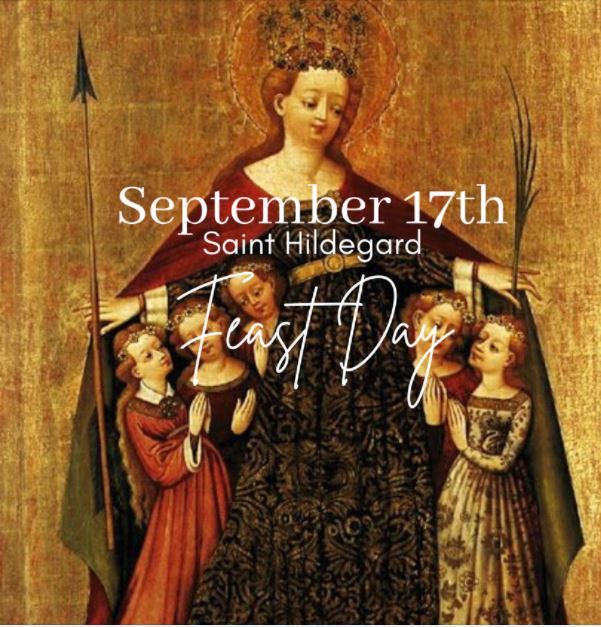
A Woman Who Defied Her Time
Despite living in a time when women were excluded from education and decision-making, Hildegard attained a level of knowledge and influence that few men of her era matched. She was the first woman in Western history to receive papal permission to write theology. She preached publicly — something women were categorically forbidden to do. She challenged bishops, abbots, and emperors when she believed they were wrong. She built her own monastery against considerable opposition and ran it on her own terms.
Throughout her writings, Hildegard consistently argued that women were equal to men in the eyes of God — equally capable of spiritual growth, equally able to understand and interpret the natural world and the mysteries of faith. In the 12th century, this was radical.
“Let your eye live and grow in God, and your soul will never shrivel.”
Hildegard von Bingen
How Her Work Has Been Embraced
Hildegard’s legacy has been carried forward by scholars, musicians, theologians, herbalists, artists, and writers — many of them women who found in her a foremother, a model, and a source of profound inspiration. Here are some of the ways her work lives on through their efforts.
Scholarship — Dr. Beverly Mayne Kienzle
Dr. Beverly Mayne Kienzle, retired Harvard professor and medievalist, produced the first English translation of Hildegard’s Homilies on the Gospels from Latin — a landmark contribution to Hildegard scholarship. Her work has helped establish Hildegard as the only medieval woman to systematically interpret the Gospels, making her accessible to English-speaking readers for the first time.
Music and Performance — Maria Jonas and Grace McLean
Hildegard’s compositions have been performed and celebrated by feminist musicians as acts of recovery and homage. Maria Jonas has devoted her career to performing and recording Hildegard’s music with Ars Choralis Coeln. Grace McLean‘s original musical In the Green — commissioned by Lincoln Center Theater and winner of a 2020 Richard Rodgers Award — brings Hildegard’s life to contemporary audiences through song and drama.
Herbalism and Natural Medicine — Brigette Mars and Kathi Keville
Hildegard’s medical writings have been recognized and celebrated by women in the herbalism tradition who see in her a founding figure of women’s contributions to natural science. Brigette Mars and Kathi Keville — both founding members of the American Herbalist Guild — have connected Hildegard’s 12th-century plant knowledge to the living tradition of herbal medicine practiced today.
Theology and Ordained Ministry — Rev. Dr. Shanon Sterringer
American theologian Rev. Dr. Shanon Sterringer has cited Hildegard’s advocacy for women’s education and spiritual authority as a direct inspiration for her own ministry. As an ordained woman priest and founder of the Community of St. Hildegard in Fairport Harbor, Ohio, she embodies exactly the kind of female spiritual leadership Hildegard pioneered.
Theological Leadership — Dr. Annette Esser
German theologian Dr. Annette Esser, founder of the Scivias Institute for Art and Spirituality and originator of the Hildegard Way, has spent her career illuminating Hildegard’s role as a leader in the medieval Church and a model for women in theology today. Her collaboration with filmmaker Michael M. Conti produced Hildegard Speaks — a documentary pilgrimage that brings Hildegard’s voice to contemporary audiences worldwide.
Art — Judy Chicago and The Dinner Party
Judy Chicago‘s landmark installation artwork The Dinner Party — a symbolic history of women in Western civilization — has been seen by more than one million viewers across six countries. Hildegard has a place setting at this table, recognized as one of the foundational women of Western intellectual and spiritual life.
Women Who Have Brought Hildegard to the Present
The following women participated in our virtual Hildegard pilgrimage programs, each bringing their own unique connection to her life and legacy — through theology, music, herbalism, writing, and spiritual community.
Meet all of these extraordinary women on the Virtual Pilgrimage Presenters page.
An Enduring Legacy
Hildegard’s impact is not limited to her own era. Her ideas and teachings continue to resonate across disciplines — in environmental theology, integrative medicine, early music, women’s history, and creation spirituality. As the abbess of her own monastery, she provided a platform for women to advance their education and pursue their intellectual and spiritual passions. Her visionary leadership challenged the male-dominated norms of her time and created space for generations of women to find their voice.
Whether you come to Hildegard through her music, her medicine, her theology, or her sheer refusal to be silent — her legacy is one of boundless creative energy, moral courage, and deep conviction that every human soul carries the greening power of God within it.
Know a woman whose work with Hildegard deserves to be celebrated? Share her story in the comments below.
Further Reading
- About Saint Hildegard von Bingen — her full life and legacy
- Who Was Saint Hildegard von Bingen? — an introduction
- Hildegard’s Music — The Ordo Virtutum Explained
- Hildegard’s Medicine and Herbs
- YouTube Channel — more videos on Hildegard’s life and legacy