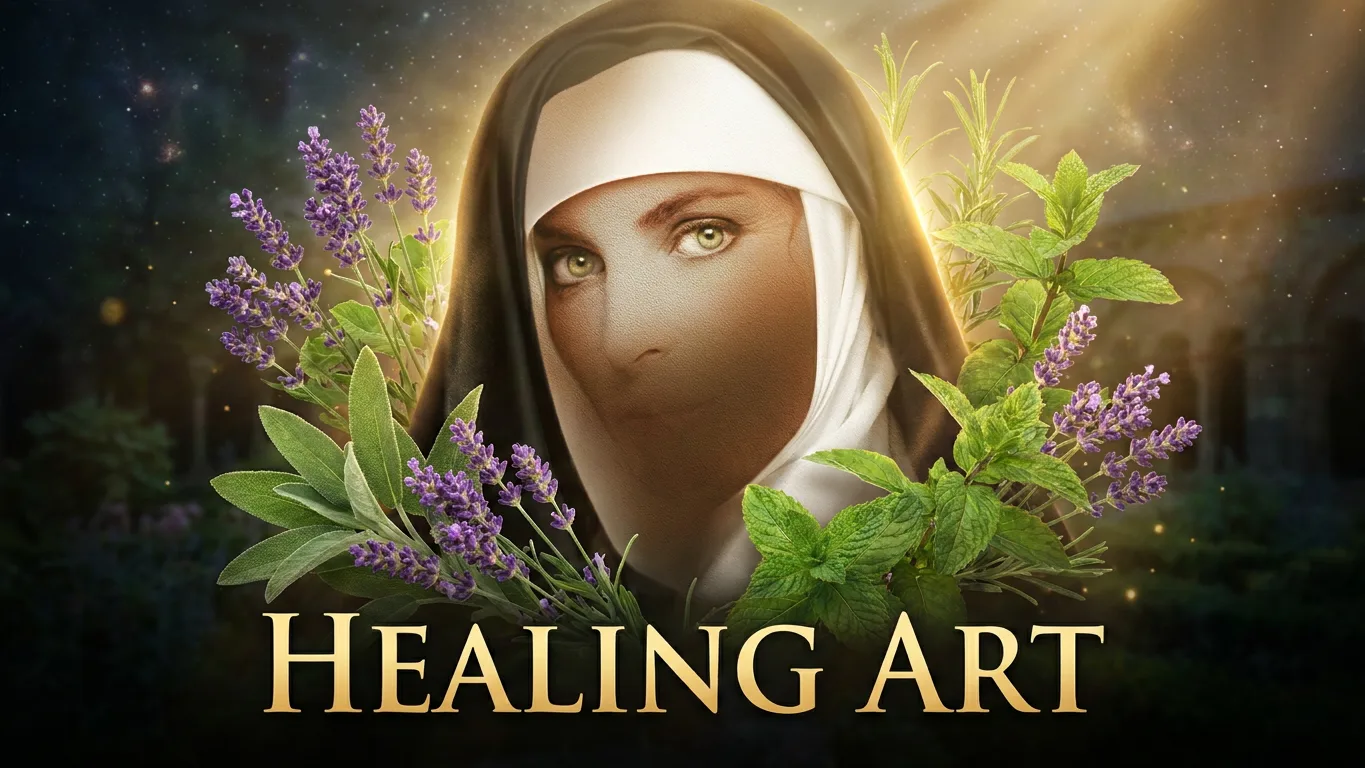
Hildegard von Bingen’s Medicine and Herbs
·
Nine centuries before integrative medicine became a field, a Benedictine abbess in the Rhineland was documenting over 200 plants, their medicinal properties, and their connection to the spiritual health of the body and soul. Hildegard von Bingen was not simply a healer — she was the founder of scientific natural history in Germany, and her medical writings remain studied and practiced to this day.
The Two Medical Works
Between 1151 and 1161, Hildegard wrote two major medical treatises that together constitute one of the most remarkable bodies of medical writing from the medieval period.
Physica — The Book of Simple Medicine
Physica presents nine categories of healing systems — Plants, Elements, Trees, Stones, Fish, Birds, Animals, Reptiles, and Metals — and elaborates on their medicinal use. The premise of Physica relates to traditional healing remedies applied in everyday life. The majority of content derives from practical knowledge aggregated through Hildegard’s personal experience.
The longest and most comprehensive section contains information concerning the medicinal uses and harvesting of more than 200 herbs and other plants. Unlike many other medieval herbals, this one contains little description of the plants for identification purposes — Hildegard was writing for practitioners who already knew what the plants looked like. She was focused on what they could do.
Causae et Curae — Causes and Cures
Causae et Curae focuses on the human body and its connection to the rest of the natural world, detailing home remedies for common ailments — likely discovered in the monastery’s physic garden which she led. Where Physica is encyclopedic in scope, Causae et Curae is more personal and clinical — a guide to diagnosis and treatment grounded in Hildegard’s understanding of the humors, the seasons, and the spiritual dimensions of illness.
“The soul is a breath of living spirit, that with excellent sensitivity, permeates the entire body to give it life. Just so, the breath of the air makes the earth fruitful. Thus the air is the soul of the earth, moistening it, greening it.”
Hildegard von Bingen
Her Approach to Healing
Hildegard’s medicine was holistic in the truest sense — she understood illness not as a mechanical failure of the body but as a disruption of the divine life force, viriditas, that flows through all living things. A person who was ill had lost their greening power. Healing meant restoring it — through plants, diet, rest, spiritual balance, and the reconnection of the body with the rhythms of the natural world.
She worked within the medieval humoral tradition — understanding health as a balance of four humors: blood, phlegm, yellow bile, and black bile — but she brought to it a distinctly personal and empirical approach. The plants she used are generally those which could be collected from the woods and fields or grown in the convent garden. She was writing from lived experience, not solely from inherited authority.
Key Herbs in Hildegard’s Pharmacopoeia
In her works she offers 437 claims of health benefits from 175 different plants. Many of these are herbs still found in gardens and health food stores today. Here are some of the most significant:
Galangal
Hildegard’s most celebrated remedy — a warming spice she recommended for heart conditions, digestive problems, and as a general tonic for vitality.
Fennel
One of her most frequently mentioned herbs — used for digestive complaints, to ease childbirth, and as a general strengthener of the whole body.
Lavender
Recommended for calming the mind and purifying the spirit — Hildegard understood its effects on mood and mental clarity long before modern aromatherapy.
Hyssop
Valued for lung and respiratory ailments — Hildegard prescribed it for cleansing the chest and easing breathing difficulties.
Wormwood
Used in moderation as a bitter tonic — Hildegard understood its strengthening properties while being clear about the dangers of excess.
Parsley
Prescribed for its cleansing and diuretic properties — one of the most common herbs in her garden and one of the most frequently prescribed.
Was She Right?
This is the question modern scientists have asked — and the answer is striking. A team of German and Swiss scientists examined Hildegard’s writings, particularly Physica and Causae et Curae, and found that her 437 claims of health benefits from 175 different plants showed a level of accuracy far beyond chance. For example, her recommendation of cloves for digestive complaints aligns with modern pharmacological understanding of eugenol, the active compound in cloves.
Hildegard von Bingen’s approach to nature is over 800 years old — yet surprisingly modern. Her holistic view of humanity, her appreciation of plants, and her conviction that health arises from harmony with nature resonate with many people today. The practice of “Hildegard medicine” has been kept alive in Germany by practitioners including Dr. Gottfried Hertzka and Dr. Wighard Strehlow, who have spent decades applying her protocols in clinical settings.
The Monastery Garden
The physic garden — the medicinal herb garden of a monastery — was Hildegard’s laboratory. At Disibodenberg and later at Rupertsberg, she cultivated the plants she wrote about, observed their effects across seasons and in different patients, and refined her understanding through practice. The tradition of monastery herb gardens she helped establish is still visible in the Rhineland today — the gardens at the Abbey of St. Hildegard in Eibingen maintain this legacy directly.
When you walk the Hildegard Way in September and visit the Abbey at Eibingen, you walk past those same gardens. The herbs growing there are the same herbs she described. It is one of the most tangible connections the trail offers to her actual daily life.
Working with her herbs invites us to look more consciously — at what nourishes, heals, and strengthens us. Without dogma, but with a deep respect for the wisdom of nature.
Hildegard’s Herbs — shop-hildegard.com
Medicine and Viriditas
For Hildegard, medicine and theology were not separate disciplines. The healing power of plants was an expression of viriditas — the greening power of God flowing through creation. An herb did not simply contain active chemical compounds. It contained the living light of the divine. To prescribe it was to work with the grain of creation, not against it. To ignore it — to let a person dry out, lose their vitality, grow cold — was a failure of spiritual stewardship as much as medical care.
This is what makes Hildegard’s medicine so distinctive and so enduring. It is not simply a list of folk remedies. It is a complete philosophy of the relationship between the human body, the natural world, and the divine — expressed in practical, specific, usable form.
Further Reading
- About Saint Hildegard von Bingen — her full life and legacy
- What Is Viriditas? — Hildegard’s theology of the greening power
- Who Was Saint Hildegard von Bingen? — an introduction to her life
- Walking the Hildegard Way in Germany — visit her monastery garden in person
- YouTube Channel — more videos on Hildegard’s life and work